JournalGuide11 min
Off-plan and secondary in one catalogue: what a Dubai agency needs
Off-plan arrives from the developer as a price list and a payment plan. Secondary arrives from the owner with a Form A and an advertising permit. Below: how the two differ in law, what breaks in a shared spreadsheet, and what a shared property record should hold.


A client writes on WhatsApp: "Two-bed in Business Bay, up to three million, off-plan is fine." The broker opens the secondary spreadsheet, then a folder of developer price lists, then a chat with a colleague who went to a launch last week. An hour later the client has five options, and two of them are already sold. This isn't sloppiness. The law treats off-plan and secondary differently, and the buyer's money travels a different route in each.
Why agencies keep two lists
Off-plan stock comes from the developer: a price list in PDF or Excel, an availability sheet, a payment plan split across construction stages and handover, and the rules of the launch. Before a launch, developers often collect EOIs, expressions of interest with a payment attached. An EOI reserves interest in a unit but gives no ownership, and whether the money comes back depends on the developer's terms (dubizzle). At a busy launch availability can change several times a day, and only the developer knows it for sure.
Secondary stock comes from the owner. The broker signs a marketing agreement with them and gets an advertising permit. The listing broker knows the status. So does the owner, who could sell through another agency tomorrow.
- 62.6%
- off-plan share of Dubai transactions in 2025
- 134,623
- off-plan sales in 2025, worth AED 293 billion
- 76%
- off-plan share of the residential market in June 2026
2025 figures are DLD data quoted in the Bayut report; June 2026 is from Gulf News, which cites Cavendish Maxwell for its sales data. The methods differ, so the numbers are not directly comparable.
With a split like that, we think the old setup where a separate team handles off-plan has stopped working. Buyers come with a budget and an area. Whether it ends up ready or under construction is often settled during the search.
What DLD and RERA require on each side
First, what the regulator says. The table is built from DLD and RERA documents, linked in the text and at the end.
| Item | Off-plan | Secondary |
|---|---|---|
| Right to advertise | Registered project with an escrow account, plus a marketing contract with the developer | Contract A (Form A) with the owner |
| Advertising permit | Through Trakheesi, number shown on every ad | Through Trakheesi, number shown on every ad |
| Contract with the buyer | Sale and purchase agreement with the developer | Contract F (Form F) between seller and buyer |
| Where the money goes | Only into the project escrow account | To the seller on the agreed terms |
| Registration | Interim register via the Oqood portal, within 90 days of signing | Main DLD register on transfer of title |
Off-plan: escrow, Oqood and the developer contract
Dubai Law No. 8 of 2007 requires a developer selling off-plan to apply to DLD for a project escrow account (Article 6) and bars advertising without written approval from DLD (Article 5). The developer's creditors cannot attach the money in that account (Article 9). Projects are registered through a DLD e-service, and one of its conditions is that the developer itself is registered in Trakheesi.
Law No. 13 of 2008 requires dispositions of off-plan units to be entered in the interim register. If a developer sells through a broker, that broker contract is registered with DLD too (Article 9). In practice this runs through the Oqood portal. According to the DLD service page, the sale and purchase agreement goes into the interim register within 90 days of signing, and the buyer receives an electronic certificate.
RERA gives brokers the same message in its Real Estate Brokerage Practice Guide 2024. Before marketing off-plan, make sure the project is licensed and registered and has an escrow account, and tell buyers to pay only into it. A marketing contract between the developer and the agency is required as well. Brokers can check a project in the Dubai REST app under Mashrooi. Exhibitions are stricter still: under the advertising permit page, off-plan units not registered with the escrow accounts department cannot be shown on a stand.
Secondary: Form A, Trakheesi and Madmoun
RERA's guide also lists three smart contracts: A between the seller and the agency for marketing, B between the buyer and the broker, F between the seller and the buyer. Since 1 August 2022, Form A has been linked to the permit system. Under DLD circular 01-2022, the broker applies for an ad permit using the Form A contract number. From 24 April 2023, every permit carries a Madmoun QR code that buyers scan to verify the ad. Bayut shows the code on a listing once the agent enters the permit number (Bayut).
Fines are real. In October 2020 RERA fined ten companies and warned thirty more for ads without permits, misused permit numbers and expired permits. The fine is a progressive AED 50,000, and a case can go as far as cancelling the company's licence.
What breaks when you merge the lists
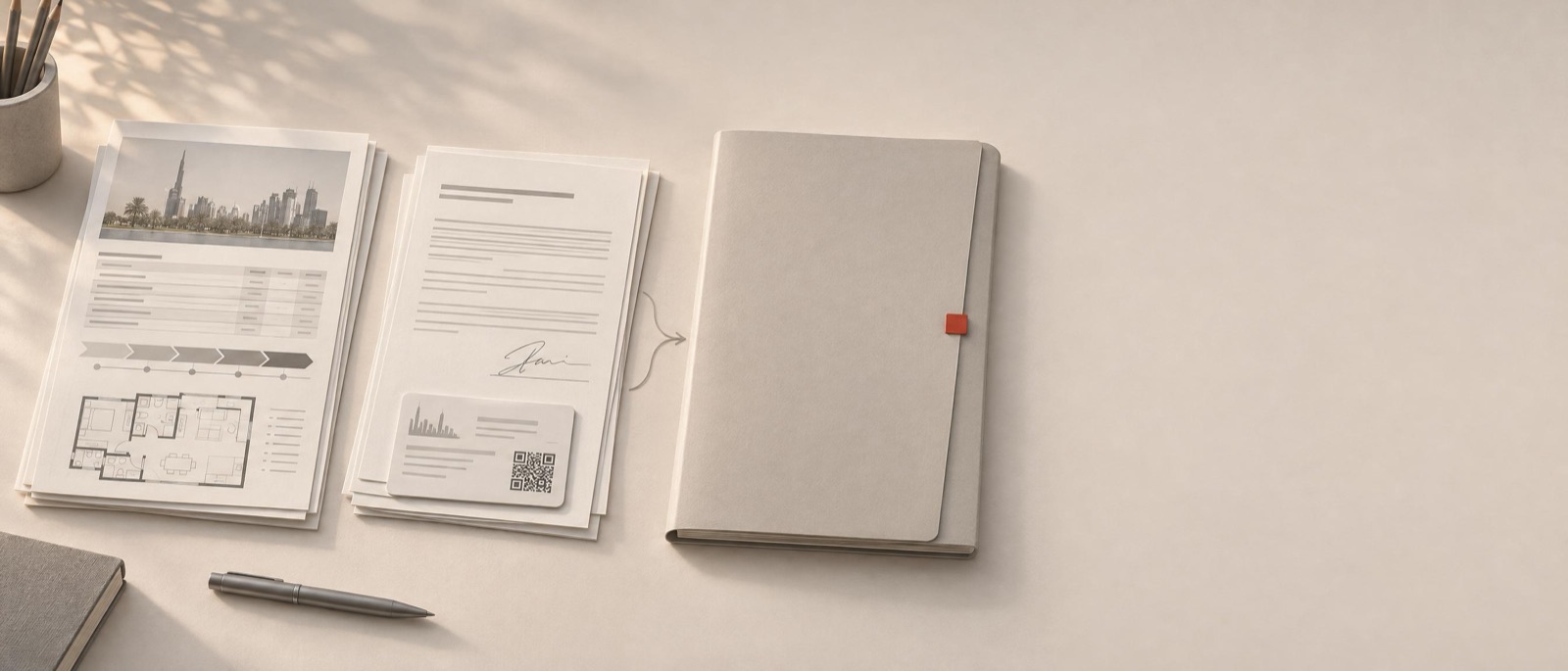
Most agencies take a shortcut: paste the price lists into the secondary spreadsheet and add a "type" column. A month later the spreadsheet is wrong. Here is where.
Unit status goes stale
On secondary, the broker updates the status. On off-plan, the developer does, and the agency finds out from the next price list. If the record has no price list date and no source, the broker sends the client a unit that sold last week.
The basis for advertising gets lost
A secondary listing needs a live Form A and a permit. Off-plan needs a developer contract and a registered project. With one shared "permit" field, nobody can say six months later on what basis a unit is sitting on a portal.
Price stops being one number
Secondary has an asking price and room to negotiate. Off-plan has a list price, a payment plan and sometimes a launch discount. Putting them in one column compares things that are not alike.
The same unit shows up twice
Law No. 13 allows a unit recorded in the interim register to be sold on (Article 6). So a flat in a tower under construction can come from the developer's price list and from an investor reselling their contract. Without a link to the project and the unit number, these become two records with two prices.
Money goes to the wrong place
On off-plan, the buyer pays only into the project escrow account. Secondary works differently. If the record doesn't tell the broker which case this is, a wrong payment instruction is no longer something a call to accounts can fix.
What a shared property record should hold
One catalogue works when off-plan and secondary share a skeleton, and the differences sit in separate fields that are mandatory for their type. We would split the record into five tabs.
Where it is
Project, building, unit number as it appears in DLD documents, area, floor, size, view. The same unit from a price list and from a reseller should resolve to one record.
To us, the fifth tab matters most. Catalogues rarely get the size of a flat wrong. What they get wrong is whether a unit is still free and whether it can be advertised today. Keep those fields with a source and a date.
Where we fit in
We build INSIS, a system for agencies in the UAE, so this part is short. Off-plan and secondary sit in one catalogue. All of an agency's WhatsApp numbers and email are on one screen. AI sorts incoming leads and drafts replies, and the assistant creates clients, deals and listings when asked in chat. Everything the AI prepares is a draft: a person confirms price, discounts and answers about visas, taxes, residency and ownership. A deal calculates the commission, and the payout register goes for signature. We are building the system with working brokers in Dubai and opening access to agencies one at a time.
Questions
Can a broker advertise an off-plan project without a developer contract?
RERA's Brokerage Practice Guide 2024 requires a marketing contract between the developer and the agency, and the project must be licensed, registered and have an escrow account. The ad permit is issued through Trakheesi.
What is Oqood?
DLD's portal for developers, used to record off-plan sales in the interim register. According to the DLD service page, the sale and purchase agreement is registered within 90 days of signing and the buyer receives an electronic certificate.
How is Form A different from Form F?
Form A is the marketing agreement between the seller and the agency, and its number is used to apply for the ad permit. Form F is the sale contract between seller and buyer on the secondary market. Form B is the buyer's agreement with a broker.
Does a listing need a Madmoun QR code?
A QR code is issued with every advertising permit. Since 24 April 2023 DLD has required it on print and audiovisual ads, and Bayut shows it on a listing once the agent enters the permit number.
Sources
- Dubai Legal Portal: Law No. 8 of 2007 on escrow accounts
- Dubai Legal Portal: Law No. 13 of 2008 on the interim register
- DLD: register a project and escrow account
- DLD: request to register the initial sale (Oqood)
- DLD: real estate ad permit
- RERA: Real Estate Brokerage Practice Guide, 2024
- DLD circular 01-2022: Form A and ad permits
- DLD, 18 April 2023: Madmoun service and QR codes
- DLD, 20 October 2020: fines for advertising violations
- Bayut: Dubai Off-plan Market Report 2025
- Gulf News, 6 July 2026: Dubai homes record Dh221.3b sales in H1 2026
- Bayut: agent's guide to DLD Madmoun
- dubizzle: Expression of Interest in UAE real estate